A Wave Has Turned Up
Why the AI wave doesn’t fit the last three digital waves
On a trip to Japan recently, I got to see Thirty-six Views of Mount Fuji, by Katsushika Hokusai.
You know one of these images. The great wave. It’s famous.
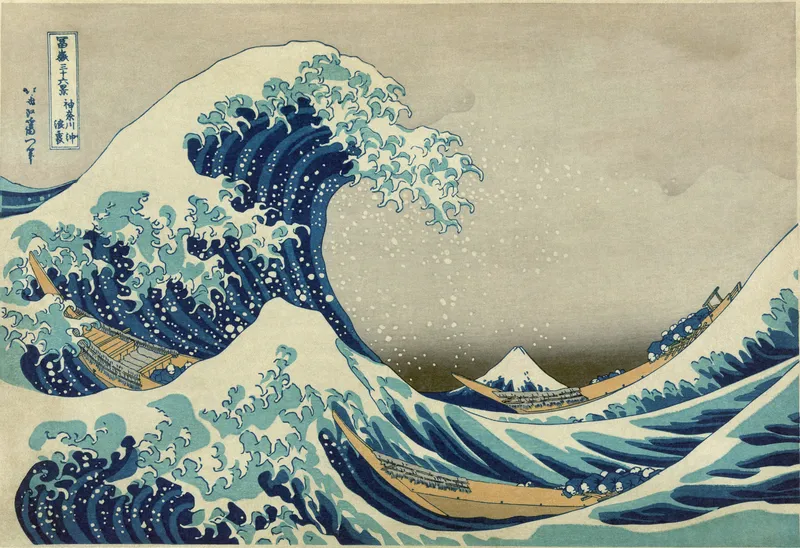
Part of what made it famous in the West was the French impressionists — but to get there, the technology had to travel first. The intense blue that holds Hokusai’s wave together is Prussian blue, a pigment that didn’t exist in Japan a generation before he used it. It was synthesised by accident in a Berlin laboratory early in the eighteenth century and reached Japan slowly, through Dutch traders, decades before the country opened more widely. That European chemistry is what let Hokusai paint the wave the way he did, around 1831.
Then the loop turned in the other direction. When Japan opened to the world later that century, Hokusai’s prints travelled to France, and the impressionists fell for them — the flatness, the framing, and that blue. You can see the influence downstream in Van Gogh’s Starry Night. A pigment crossed from Europe to Japan, became a masterpiece, and crossed back as a way of seeing.
That traversing of technology through culture — the feedback loop, the evolutionary arc — is something Kevin Kelly explored in What Technology Wants.
Technology has always infused and influenced culture, changed the shape of it. But its impact is generally thought of as a linear progression through time. In my own career I’ve lived through three distinct waves that changed the landscape. The first, desktop publishing and the personal computing revolution, was my dive from the physical print world — the world made possible by the Gutenberg press — into the digital one, though the outputs were still tangible for the most part. The second, the web, started slow and then changed commerce and knowledge creation forever. The third, mobile, amplified the web’s reach and connected us to the digital world in an almost umbilical way by making a new social network possible.
Despite the pace of those waves, it’s still been possible to design for them in heuristic, mechanistic, linear ways. Decision trees. If, then, else. Sure, there’s the squiggly line of the creative process, but it has generally moved from left to right.
With the fourth wave, AI, new design methods are already emerging in my world — new ways to navigate and map the territory.
AI isn’t only a linear progression
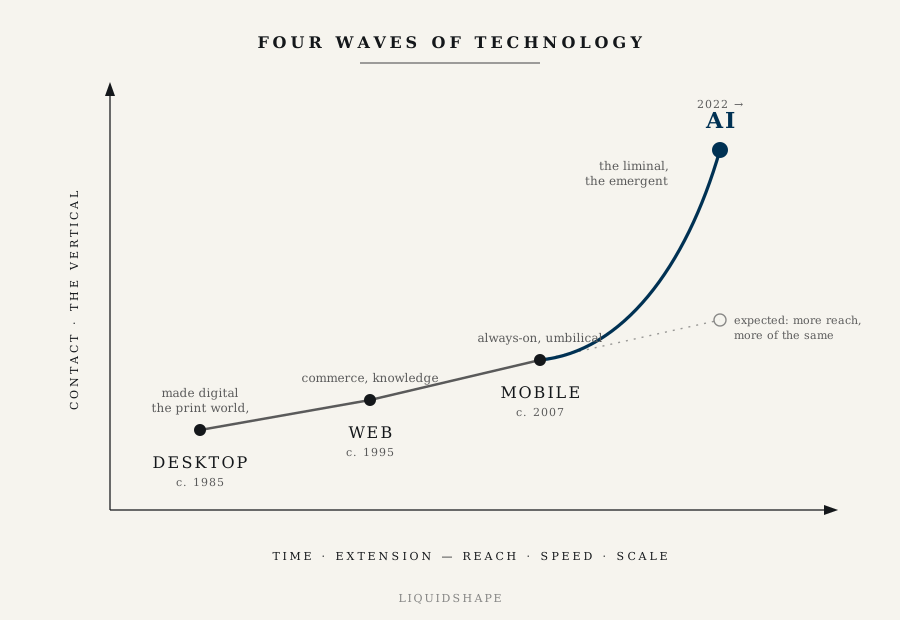
AI is already reaching into different dimensions of human experience. What I’ve mostly designed for are clearly defined tasks and interactions. What I’m finding with AI is that it’s more like designing the conditions for an entity to perform within. Defining shared goals and outcomes together. Setting up guardrails and constraints. Developing skills for scenarios.
As with agile frameworks and the techniques we use to run design teams, I find myself reaching for principles and rituals to guide independent agents. So AI — an emergent technology itself — is now in turn shaping the way I work.
The way people use AI interfaces resembles how we interact with other humans, and with trusted entities we credit with wisdom and authority, rather than with machines. Our design tools need to evolve from human-computer interaction toward something more like ritual choreography.
In turn, we can meet needs with AI that our HCI methods could never address. We have to design increasingly for the liminal and the transient — for an effectively infinite number of emergent responses and outputs.
How do you design trust into an AI adviser?
A while back, I consulted on the UX for a decision tree that delivered modified personal advice for the first time in an Australian banking digital channel. The intent was to elicit an individual’s goals and needs and present matching financial products. As you’d expect from a first iteration, it was clunky. Because it wasn’t a human conversation. It was a dense form. It didn’t flow. It was mechanistic, without nuance, without the ability to make the connections a real financial adviser makes.
But someone will eventually design for this need with AI. The question is how AI-powered financial recommendations get governed.
APRA, the prudential regulator, wrote to all the entities it oversees in April 2026 about exactly this kind of risk. The letter is clear-eyed. It even names the heart of the problem: too many firms, it observes, treat AI as “just another technology,” and in doing so miss the things that make it different — adaptive behaviour in the models, inherent bias, the ethical weight buried in design and data decisions. But naming the gap and knowing how to design across it are different things. APRA can require boards to govern AI and hold someone accountable for it. What it can’t do is tell me how to make an adviser trustworthy in the moment a real, anxious person is sitting in front of it.
Others have gone further toward that question. The Center for Humane Technology — the group Tristan Harris and Aza Raskin built after their work on attention and social media — published an AI Roadmap in 2026, seven principles for how AI should be built, deployed and governed. A good chunk of it is aimed squarely at people like me. It warns against designing AI to feel human, against what it calls the “race to intimacy,” against the engagement-maximising patterns that hooked us through the feed.
The Oxford Collaboration on Theology and Artificial Intelligence went somewhere older and stranger. They wrote an oath — modelled on the one doctors take — for the people who build AI. It asks me to approach my work with humility, and to make my work governable and an enabler of proper human judgement.
There’s a tension here I’m still sitting with. CHT’s instinct is to keep AI from feeling too human, to hold the line between person and machine. Mine, lately, has been to design the choreography of something that already behaves like an entity. Maybe those aren’t opposites. Maybe the humility the oath asks for is exactly what keeps the choreography honest — designing for presence without pretending there’s a person on the other side.
Facilitating for AI
At this stage I’m starting to design with AI agents and teams in controlled environments, with controlled outputs. My hands are off the traditional tools; I’m abstracting up to instruction and guidance. That alone is already a new way of working. Will the products we design one day adapt autonomously to changing conditions, learning from how they’re used?
Jakob Nielsen, who pioneered much of modern usability practice, now points toward the “forward deployed designer” — part ethnographic researcher, part macro-systems service designer, part AI product strategist. The role moves closer to the conditions of use and further from the artefact.
Soon we’ll reach for new toolkits, new sets of colours and pigments to communicate with, and new organisational structures to match the pace technology wants from us. Command-and-control hierarchies and fixed 2D views have become too rigid, too slow, for what we’re trying to make.
The through line across these waves is this: human desires, and humane needs — the softer ones the machines keep overlooking — will forever respond to, and feed back into, what technology wants. Hokusai didn’t invent Prussian blue. But the wave doesn’t exist without it, and neither does everything the wave went on to touch. We’re picking up a new pigment now. It’s worth paying attention to what it lets us create.