A system for setting and tracking intention
Extending my journalling system to track intention and wellbeing
I’ve had a journalling habit, in and out, for most of the last 20 years. Underneath it has always been an inclination to understand the different parts of myself, and how they come together to make the best of me — emotionally, professionally, physically, and in the other areas that don’t fit neatly into any of those. Call it work–life balance if you like, but it has always felt bigger than that. Wellbeing, in the full sense of the word.

Unstuck habits and drift
A few years ago I tried putting some structure around it. I kept an outliner with my journal entries, tasks and project notes in one place. I wrote ideal scenes for areas of my life in the present tense and at the end of every week I wrote a short review and gave the week a score out of ten. For a while it worked. It was a reasonably successful reference and it led to tangible outcomes.
But it decayed, and it wasn’t the only thing that did. Over the years I made a few attempts at positive habits: journalling, exercise routines, life coaching sessions, intentions for projects and connections. Then COVID arrived, our lifestyle changed around it, and I lost a familiar frame — an off-grid train commute through a forest that had been anchoring my weekly review. With three bouncing kids and a full working life, I was time poor, and habits didn’t stick.
When I went back through those old entries recently, I noticed something I hadn’t seen at the time. I wrote most when life was quiet — in idle stretches, flat patches, procrastinating days — and went silent exactly when things got busy. The habit disappeared at the moments it would have helped most. The entries themselves are full of soul searching and sense-making, and reflections to build confidence in what I do. There are also words of encouragement from other people tucked between the entries, kept the way the writer Craig Mod keeps a file of kind notes to read on bad days. I had the raw material. I didn’t have a way to uncover it when I needed to see it again.
Seeing the forest and the trees
That was a limitation of journalling for me. Day to day you can’t see the patterns. You have no objectivity, only subjectivity. Every entry makes sense on its own, and the links between them — the thing a good therapist does for you, connecting what you said in March to what you’re feeling in October — never get made.
Since AI tools have come along, that has changed. I’ve set up a routine that reads my entries on a Sunday evening, plays them back to me and sorts them into patterns I can make sense of. It’s currently all done over an email loop: a short prompt arrives each morning, I reply, and the reply is filed. I’ve been slowly iterating it towards web and app views.
It’s less a journal now than a prompted reflection and a brain dump. I write unstructured; the structure arrives in the review.
How the structure works
The structure came out of my work. Over the years I’ve designed wellbeing, fitness and financial products, and I’ve combined the frameworks I tested along the way. Two ideas do most of the work.
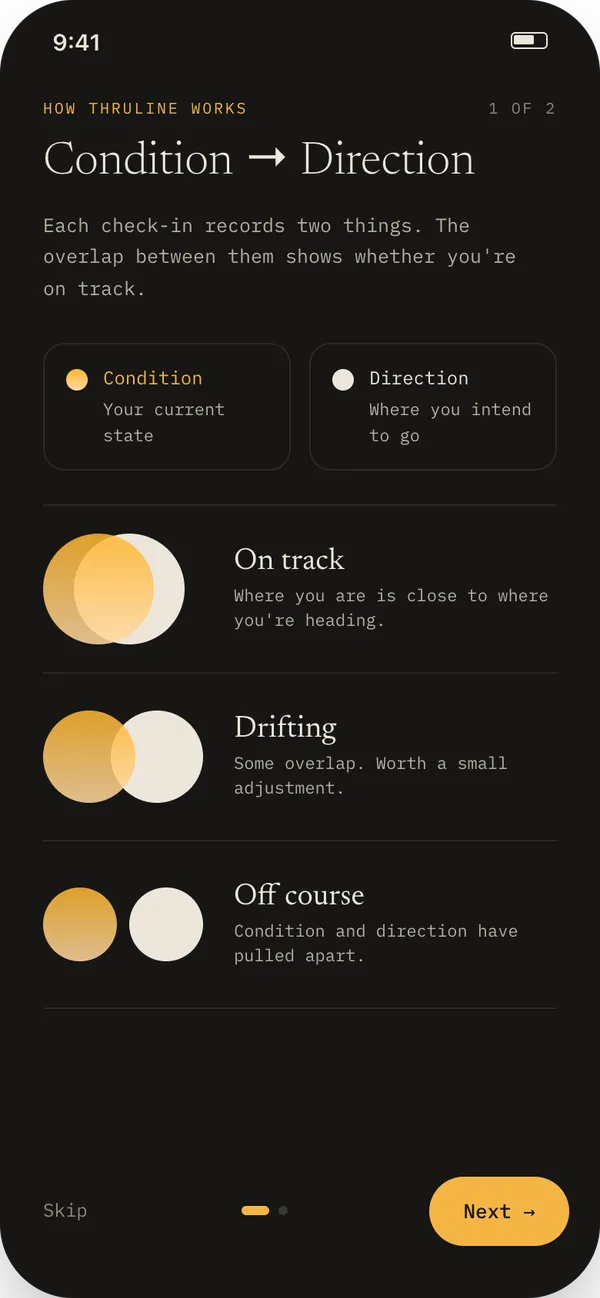
The first is that each check-in records two things, not one: your condition, where you are now, and your direction, where you intend to go. The overlap between them shows whether you’re on track, drifting or off course. There are no scores. I scored my weeks for six years and almost every one was a seven, an eight or a nine. The number never moved; the words underneath it did.
The second is that a life doesn’t split into work and not-work. Everything I write is read against eight dimensions of wellbeing — emotional, spiritual, intellectual, physical, environmental, financial, occupational and social. A single entry usually touches several at once. I never file anything; the review does it.
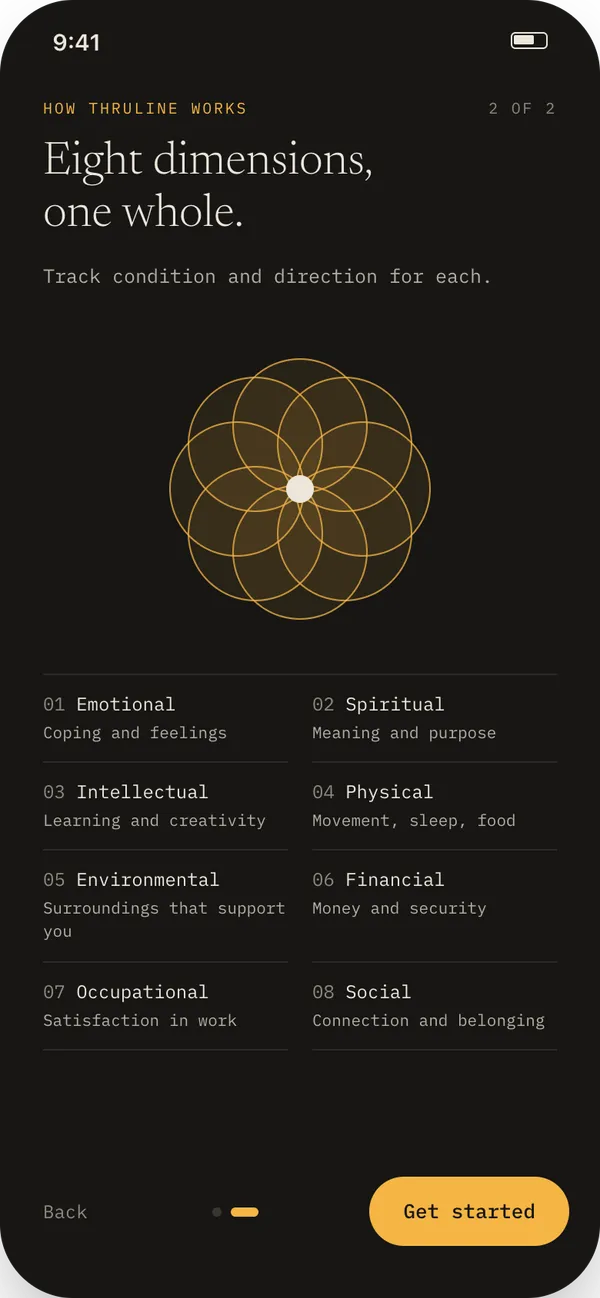
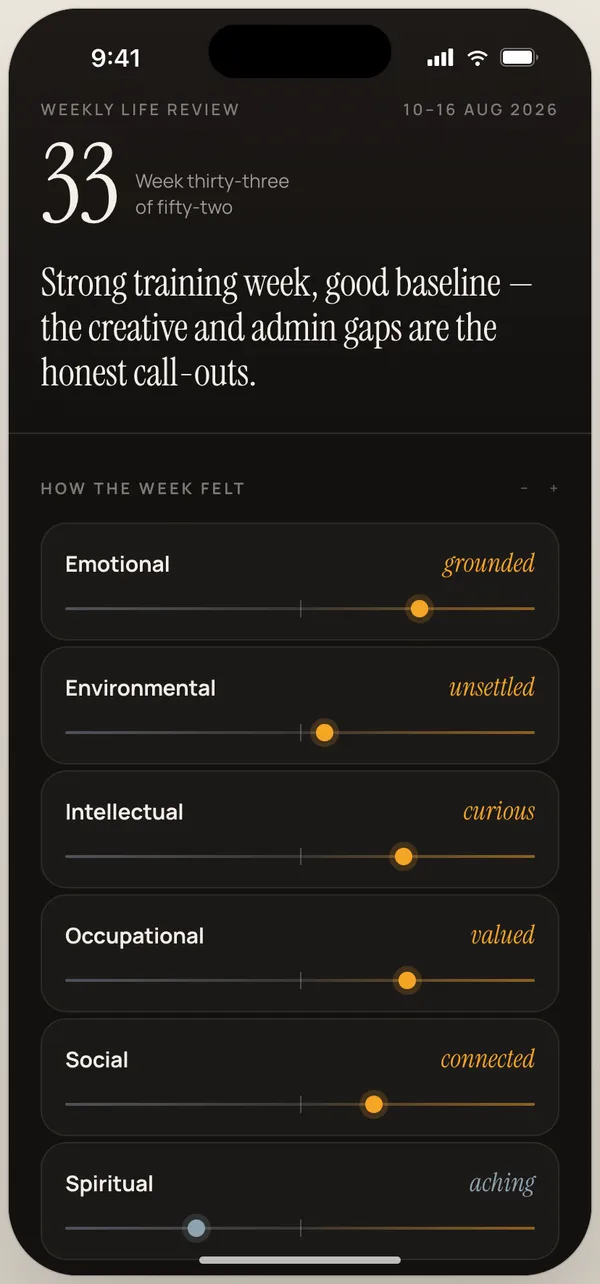
Day to day, it asks for very little: a prompt and a couple of sentences, typed or spoken. On Sunday, the week comes back to me as a review, each dimension described in words rather than numbers.
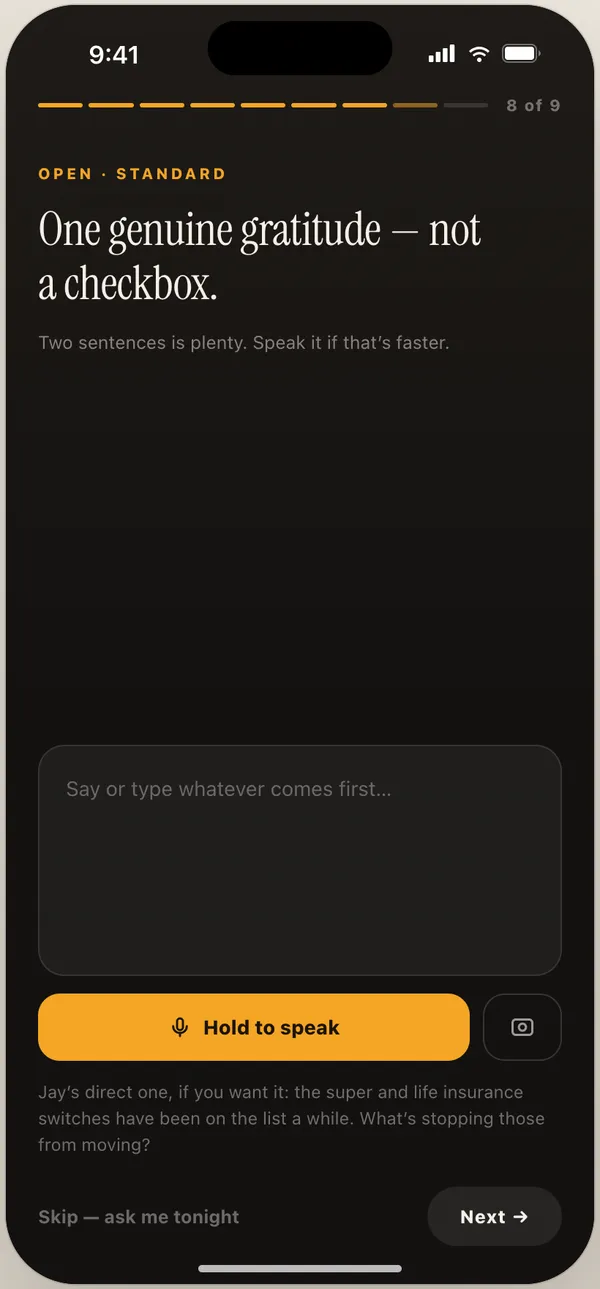
For the measurable parts of life, it goes one step further. An intention becomes a goal, the goal becomes a plan, and the plan is laid over what I actually did — training sessions, spending, the evidence. For the less tangible parts, it does something I didn’t expect: it prompts me to connect independent moments of meaning that would normally pass me by. A line from a Tuesday and a line from three weeks earlier turn out to be about the same thing. Those connections can be harnessed into action, and every so often they arrive as a welcome epiphany.
What changed
It keeps me focused and present, and with greater understanding of myself. That turns out to be where agency comes from — not from willpower, but from seeing clearly enough to act in all the small, nuanced ways life is lived. It has helped me make long-planned trips a reality, get fit for interstate bike races, and bring my best self into new roles at work and back home again.
Try it
If you’d like to try a private version for yourself, write an intention for what you’d like to achieve. In 3 months I’ll send it back to you, in your own words, and ask whether you started. If a private version is ready by then — hosted, or self-hosted on your own system — I’ll let you know and help you get started.